Before You Go to Heaven
Before you reach the second day, examine the first.
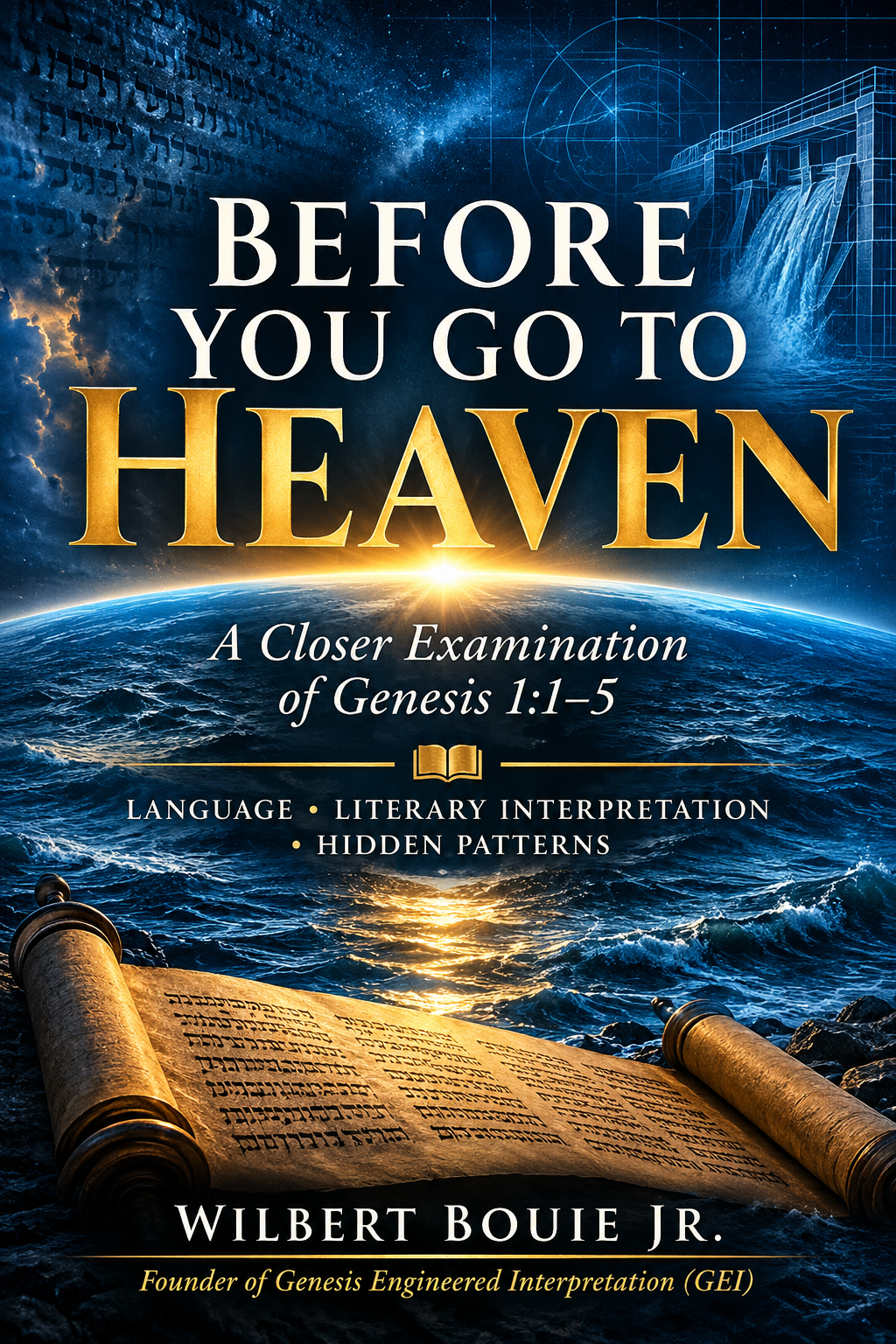
A provocative examination of Genesis 1:1–5 through language, literary structure, translation, punctuation, and the alternative interpretive possibilities explored by Genesis Engineered Interpretation.

What Readers Will Examine
Genesis 1:1–5 examined through multiple lenses of language, structure, and interpretation.
Language & Translation
Homophones, homonyms, synonyms, antonyms, and Hebrew terminology explored alongside modern English sound-play and translation decisions.
Literary Structure
Parallelism, chiasmus, irony, metaphor, simile, allegory, and the role of figurative language within the creation narrative.
Punctuation & Division
How commas, colons, semicolons, verse boundaries, and chapter divisions shape what readers believe they are seeing in the text.
Conventional & Alternative Readings
Familiar interpretations presented alongside GEI hypotheses, clearly distinguished so readers can evaluate the evidence independently.
Engineering Comparisons
GEI’s hydraulic and engineering lens applied to the creation sequence—offered as hypotheses for examination, not established conclusions.
The First Day
The beginning, earth, darkness, the deep, waters, divine speech, light, separation, naming, evening, morning, and the numbered day.
Genesis Engineered Interpretation
Genesis Engineered Interpretation (GEI) is an independently developed alternative framework that examines Genesis 1–6 through language, literary structure, water systems, and engineering comparisons.
The Adam A-DAM hypothesis is one of the central proposals within this framework, exploring the possibility that familiar biblical descriptions may also be examined through a hydraulic and engineering lens.
GEI presents its connections as hypotheses offered for examination—not established conclusions of biblical scholarship, archaeology, or engineering. Readers are encouraged to compare the GEI interpretation with conventional scholarship and assess the evidence independently.
Examine Before Explaining
Before You Go to Heaven concentrates on the opening sequence of Genesis—the first day, Genesis 1:1–5. The title is deliberately provocative: Genesis 1:8 introduces the naming of the firmament as Heaven on the second day. This volume asks what assumptions readers bring to the threshold before that naming occurs.
Readers will encounter conventional readings and GEI alternatives side by side. Sometimes the evidence supports a strong linguistic observation. Sometimes it permits more than one translation. Sometimes GEI offers a creative analogy that remains unproven. Those are different categories, and a serious investigation keeps them separate.
The book prepares readers to approach Day Two and the appearance of Heaven in Genesis 1:8 with sharpened attention to language, structure, and interpretive choices.
Wilbert Bouie Jr.